
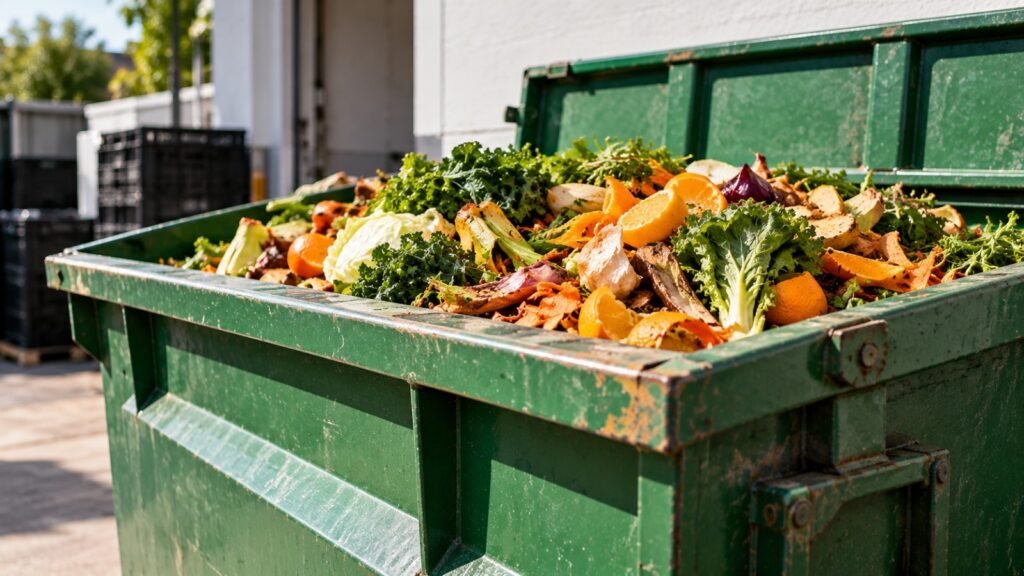
What’s changing, when it applies, and how hospitality businesses can get ahead of it.
If you run a restaurant, café, pub, club, hotel or other food business in NSW, you’re going to hear a lot more about FOGO over the next few years.
Getting ready for the changes shouldn’t simply mean ordering another bin. It is also an opportunity to understand what your business is throwing away, why it is being wasted and what could potentially be prevented before it reaches the bin at all.
At The Table Food Consultants, we see FOGO and food-waste prevention as two connected but different things. FOGO deals with what happens once food has become waste. Good food-waste management looks further back through the operation and asks why that food became waste in the first place.
What is FOGO?
FOGO stands for Food Organics and Garden Organics. NSW has introduced statewide requirements aimed at reducing the amount of food and organic material being sent to landfill and increasing the amount that is recovered.
For hospitality businesses there is an important distinction. Although the broader program is referred to as the FOGO mandate, relevant businesses are specifically required to have a source-separated food-organics collection service once they fall within the relevant thresholds.
The requirements were introduced through the Protection of the Environment Legislation Amendment (FOGO Recycling) Act 2025, which amended the Protection of the Environment Operations Act 1997 to establish requirements for the source-separated collection of food-organics waste from businesses.
“The mandate tells you to separate it. We want to help you stop paying for so much of it in the first place.”
What does the FOGO mandate mean for your business?
For hospitality businesses captured by the mandate, food waste generated in the relevant parts of the operation can no longer simply be mixed into general waste.
Businesses need an appropriate food-organics collection system, including enough collection capacity for the food waste they generate. Food-organics waste must remain separate from non-organic waste during transport and be collected at least once per week.
In practical terms, this means thinking about much more than the external bin. You need to consider where food-waste containers will sit in the kitchen, whether they are easy for chefs to access during prep and service, what happens at the dish area, how external bins will be stored and how often they will need to be collected.
The team also needs to understand what belongs in the food-organics stream and what does not. A system that works on paper but falls apart halfway through a busy Saturday-night service is not going to deliver the result you need.
When does the mandate apply?
The NSW business food-waste mandate is being introduced in stages according to the weekly capacity of a premises’ general or residual waste service.
The first stage commenced on 1 July 2026, with further stages beginning in 2028 and 2030.
| From | Weekly general waste capacity |
|---|---|
| 1 July 2026 | 3,960 L or more — for example 6 × 660 L bins, 16 × 240 L bins or an equivalent combination |
| 1 July 2028 | 1,980 L or more — for example 3 × 660 L bins, 8 × 240 L bins or an equivalent combination |
| 1 July 2030 | Smaller in-scope sites, including 660 L in a single bin, 3 × 240 L bins, or at least 720 L across a combination of bins |
These are the current thresholds published by the NSW EPA, so one of the first things a hospitality business should establish is how much general-waste capacity it actually has each week.
This is about the capacity of your waste service rather than how full you think the bins are or how much food waste you think you produce. Once you know that figure, you can establish which stage is likely to apply to your business and check the current EPA guidance for any exemptions.
What about front of house?
There is currently a temporary exemption for food-organics waste generated in areas designed for customers to eat or drink, such as restaurant, café and food-court dining areas. That exemption applies until 1 July 2030.
However, this does not mean the whole hospitality business is exempt. Where a business is otherwise captured by the mandate, food waste generated in back-of-house food-preparation areas still needs to be source separated.
There are also temporary exemptions applying in some regional locations and particular circumstances. These can change over time, so businesses should always check the current NSW EPA information for their individual site rather than relying on an old article, brochure or social-media post.
How do you get ahead of FOGO?
The best time to prepare is before your compliance date. That gives you the chance to understand the operational impact, talk to your waste provider and put a practical system in place without having to rush it.
Start by confirming the weekly general-waste capacity of your business and the rollout date that applies to you. Check whether there are any current exemptions for your location or operation, and then speak with your waste provider about what food-organics services are available. Ask about bin sizes, collection frequency, costs, contamination requirements and exactly what they will and will not accept.
Then look inside the business. Food waste does not begin at the large bin sitting outside. It starts at the delivery door, in the cool room, on the prep bench, during production, at the pass and when plates return from customers.
Think about where food becomes waste and where your internal collection containers need to sit. Make the system easy enough that the team can follow it during a busy service, not just during training.
Clear labels and simple instructions matter. So does explaining why the business is doing it. If separating food waste creates unnecessary extra steps for the kitchen team, it is far less likely to become part of normal service.
Most importantly, use the change as a chance to measure what you are throwing away before you simply start throwing it away differently.
Don’t just change the bin
Moving food waste from general waste into an organics collection is an important environmental improvement, but it does not recover the money you have already spent on that food.
By the time food reaches the bin, your business may already have paid to buy it, receive it, store it, prepare it, cook it, serve it and then dispose of it.
So if a kitchen is throwing away 30 kilograms of food a day, changing the destination of that 30 kilograms is only part of the solution. The more valuable question for the business is why did the food become waste?
It might be over-ordering or poor forecasting. It might be spoilage, storage practices, over-preparation, incorrect batch sizes or portions that are simply too large. It could even be a garnish or side dish that customers consistently leave behind.
This is where food waste becomes a commercial conversation rather than just a waste-management conversation.
Food waste is profit you’ve already paid for
This is why we recommend measuring food waste as part of preparing for the mandate.
A simple starting point is to separate food waste into three practical streams.
1. Production Waste
Captures food lost through trim, offcuts, over-preparation and food produced but not served.
2. Spoilage Waste
Captures food that has expired, deteriorated, been damaged or can no longer be used.
3. Plate Waste
Captures food that comes back from the customer uneaten.
Once you can see what you are wasting, you can start to understand why it is happening. That gives you something useful to act on.
FOGO is ultimately about keeping food organics out of landfill. For a hospitality business, however, the bigger opportunity is to reduce the amount of food that becomes waste before it ever reaches that collection stream.
The approach is simple: understand when the mandate applies to you, get the right system in place, measure what you are wasting, reduce what you can and separate what remains.
Ready to look at your food waste?
Before you simply start putting food into another bin, find out what you are wasting and why.
Our Food Waste in Hospitality guide looks at how to separate food waste, what to measure and how Production Waste, Spoilage Waste and Plate Waste can help identify opportunities within your operation.
LEARN HOW TO SEPARATE, MEASURE + REDUCE YOUR FOOD WASTE →Want more practical tools?
Explore The Table Food Consultants’ hospitality sustainability resources, practical guides and tools.
EXPLORE MORE RESOURCES →Questions? Reach Out
The Table Food Consultants Practical hospitality sustainability that works in the real world.
Natalie Bolt
natalie@thetablefoodconsultants.com.au
info@thetablefoodconsultants.com.au
www.thetablefoodconsultants.com.au
This article provides practical hospitality guidance and is not legal advice. NSW FOGO requirements, thresholds and exemptions may change. Businesses should check current NSW EPA information to confirm the obligations applying to their individual premises.
Official Mandate References
NSW EPA — Business Food Waste
Current business guidance, rollout thresholds and preparation information.
View NSW EPA business food-waste guidance →NSW EPA — FOGO Mandates and Rollout
Official information on the NSW mandate and staged implementation.
View FOGO mandates and rollout →NSW EPA — FOGO Exemptions
Current front-of-house, regional and other exemptions.
View FOGO exemptions →NSW Legislation — Protection of the Environment Legislation Amendment (FOGO Recycling) Act 2025
Legislation establishing the source-separation framework.
Read the legislation →